Pacifiers and Breastfeeding: 10 Frequently Asked Questions Answered
A pacifier and breastfeeding go well together, as long as breastfeeding is well established first. For many babies that is after a few weeks, sometimes already in the first week after birth. If your baby is growing well and drinks well at the breast, you don't necessarily need to wait four weeks. Use the pacifier in moderation, so it doesn't replace feeds. Below you'll find the answers to 10 questions parents often ask us.
1. Can I give a pacifier while breastfeeding?
Yes. A pacifier meets your baby's need to suck and has a calming effect. That is handy at moments when you can't put your baby to the breast straight away. Start with the pacifier once breastfeeding is going well. Unsure about the timing? Talk to your maternity nurse, midwife or lactation consultant.
2. Do you really need to wait four weeks before giving a pacifier?
Not always. The advice not to give a pacifier in the first four weeks comes from breastfeeding care: your baby first needs to learn to combine sucking, swallowing and breathing well. Baby nurse Esther van Bloemen-Bartels explains that this advice mainly applies when drinking at the breast isn't going well yet. Has a full-term baby been drinking well for a few weeks, does your baby have enough wet nappies and is your baby growing well? Then you can calmly offer the pacifier.
3. Which pacifier suits breastfeeding?
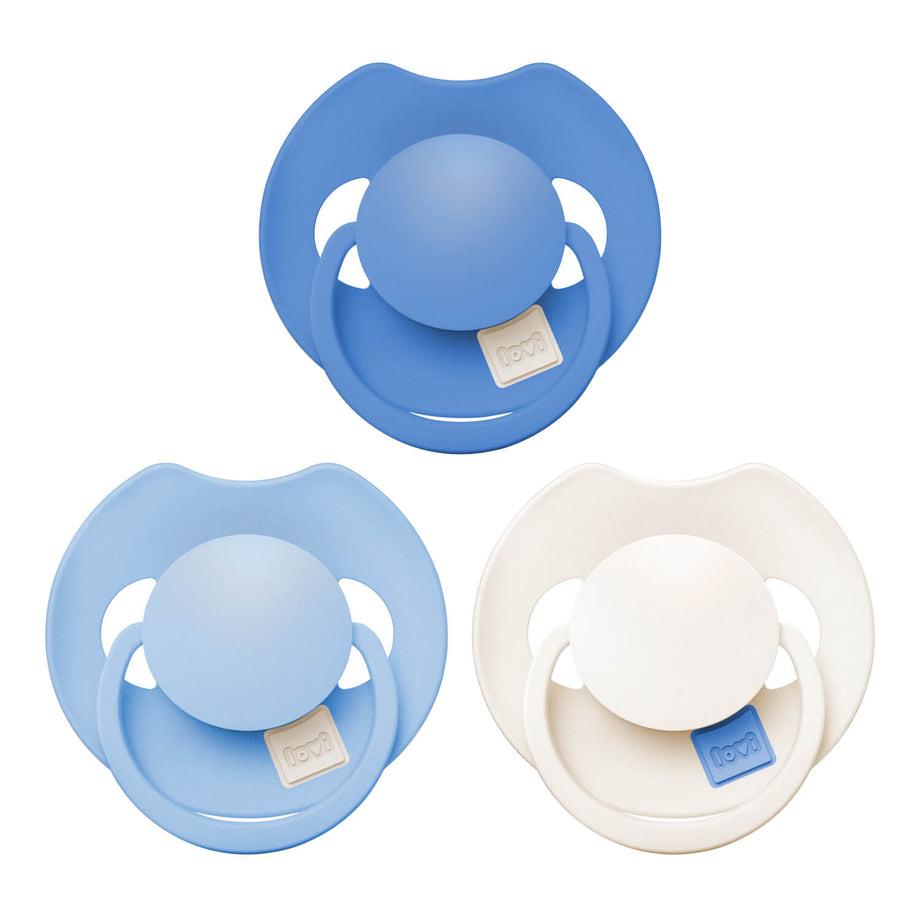
Choose a pacifier that doesn't confuse your baby's sucking technique. The Difrax LOVI Dynamic pacifier is made for breastfed babies. The teat consists of several layers of silicone of different thickness. When your baby sucks, the teat stretches slightly and then returns. This way the pacifier moves with your baby's natural sucking rhythm and protects the natural sucking reflex. The Difrax Natural pacifier, with a symmetrical oval teat, is also well accepted by many babies. Read more about the different teat shapes.
4. What is nipple confusion and does it really exist?
By nipple confusion, parents mean that a baby has trouble drinking at the breast after sucking on a pacifier. Babies know two ways of sucking. In nutritive sucking, at the breast or bottle, sucking, swallowing and breathing alternate rhythmically. In non-nutritive sucking, on a pacifier, there are short series of sucking movements without swallowing. This helps your baby calm down. Because these are two different ways of sucking, confusion is unlikely in a baby who already drinks well. Is drinking at the breast not going smoothly yet, as often happens in the first days? Then wait a little longer with the pacifier.
5. What are the pros and cons of a pacifier alongside breastfeeding?
A pacifier can calm and comfort your baby between feeds, also when your baby isn't hungry but does want to suck. A pacifier is also easier to wean off than a thumb. The downside: if you use the pacifier too often, your baby may feed at the breast less often. As a result, your baby gets less milk and your milk supply can drop.
6. Will my baby want the breast less often if I give a pacifier?
That can happen if the pacifier meets a large part of the need to suck. Your baby then asks for the breast less often, and your breasts are stimulated less. So watch your baby's hunger cues and always offer the breast first when your baby is hungry.
7. Can a pacifier help with night feeds?
Sometimes. If your baby wakes at night for comfort rather than hunger, a pacifier can help them fall back asleep. Night feeds do remain important in the first months, for your milk supply and for your baby's growth.
8. Can a pacifier affect my milk supply?
Yes, with frequent use. Your milk supply depends on how often and how well your baby drinks at the breast. If the pacifier replaces feeds, your breast is stimulated less often. So the advice is to use it in moderation.
9. When is the best time to give the pacifier?
Between feeds, when your baby wants to suck but isn't hungry. For example after a feed when your little one still wants to suckle, or when your baby is restless and has trouble falling asleep. Never use the pacifier to replace a feed.
10. Which pacifier size do you choose for a newborn?
For newborns there is the Newborn size, with a small shield and teat. Read in pacifier size by age which size suits and when to switch.
Every child is different. Do you have questions about breastfeeding and pacifier use? A lactation consultant, midwife or child health clinic will be happy to help.