Difrax Hands-free Breast Pump
Hands-free Breast Pump Instructions
Welcome to the instruction page for the Hands-free Breast Pump! Here you'll find step-by-step explanations and useful tips and videos to help you get started. Whether you're a beginner or looking for more in-depth information, this page offers clear and practical guides. Don't hesitate to contact our customer service if you need additional help.

Difrax Hands-free Breast Pump
Disassemble
Difrax Hands-free Breast Pump
Pouring milk
Get started quickly with the Hands-Free Breast Pump
See the quick guide for a brief and clear explanation on how to use your breast pump.


How do I choose the right breast shield size?
View the nipple map for more information and a detailed size chart.


Hands-free Breast Pump FAQs
Use
What intensity settings does the breast pump have and what setting is best to start with?
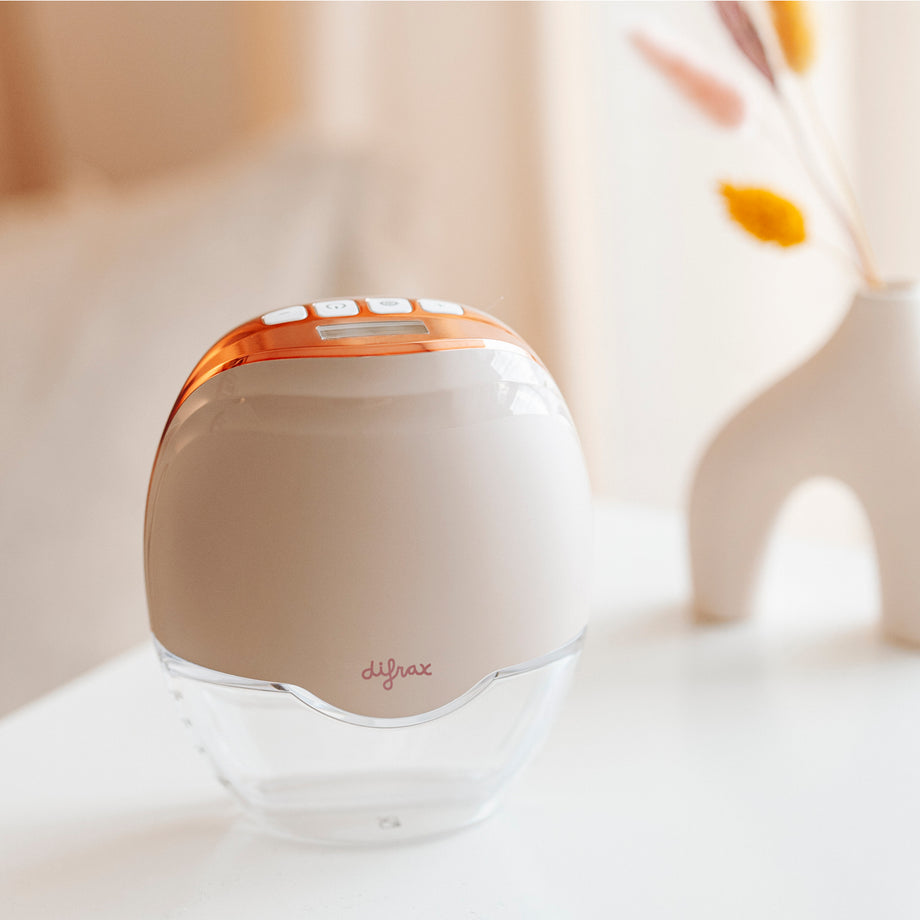
The Difrax Hands-free Breast Pump is a 2-phase pump. Phase 1 is the stimulation mode. The pump makes short suctions to trigger a let-down reflex. This means that the milk starts to flow. We recommend starting your pumping session in phase 1. Phase 2 is the expression mode. You have the choice to use the regular expression mode or the intensive expression mode. In both phase 1 and phase 2, all modes have 8 levels of suction power and speed. The pump has enough suction levels to find the right suction power for different preferences and situations.
Please note! Pumping should not be painful, and the highest setting is not always the best or fastest setting. The setting at which the milk starts to flow well is the correct setting. The correct setting may differ per breast or per pumping session. It is normal for the milk not to flow constantly, but to have small pauses. We recommend returning to let-down mode or switching breasts if you are pumping with a single breast pump.
What kind of suction power can I expect?
The Difrax breast pump is a 2-phase pump. Phase 1 is the stimulation mode. The pump makes short suctions to trigger the let-down reflex. This means that the milk starts to flow. We recommend starting your pumping session in phase 1. Phase 2 is the expression mode. You have the choice of using the regular expression mode or the intensive expression mode. In both phase 1 and phase 2, all modes have 8 levels of suction power and speed. The pump has enough suction levels to find the right suction power for different preferences and situations.
Please note! Pumping should not be painful, and the highest setting is not always the best or fastest setting. The setting at which the milk starts to flow well is the correct setting. The correct setting may differ per breast or per pumping session. It is normal for the milk not to flow continuously, but to have small pauses. We recommend returning to the let-down mode or switching breasts if you are pumping with a single breast pump.
Is it possible to do other activities while pumping?
Yes, you can. However, make sure your upper body remains upright during pumping. Do not lean forward or backward more than 45°. If you are not yet very experienced in pumping, we recommend incorporating a rest period during the pumping session. Holding your baby during pumping can also be stimulating.
How quiet is the Difrax breast pump?
The electric breast pump is discreet and quiet, with a noise level of a maximum of 50 decibels in its most intense mode.
Can I use the breast pump while breastfeeding?
Indeed! The breast pump is a useful tool during the breastfeeding period. In the initial phase, the pump can help to establish or maintain breastfeeding, especially when latching on to the breast is not yet optimal. This often happens under the guidance and advice of a professional, such as a lactation consultant or maternity care assistant.
The pump can also be used during the breastfeeding period to build up a supply of expressed milk. This is useful for times when you cannot physically feed, for example, because you have returned to work or temporarily need to supplement with expressed milk under the supervision of a professional.
Does the breast pump have anti-leak protection so that milk cannot flow back?
We advise you to keep the pumping volume in the container below 120 ml and to avoid making large movements such as jumping, running, shaking, or other actions that could cause a fluctuation during pumping. Keep the container upright once the milk has been pumped. The angle should not exceed 45 degrees.
Is a double version of this breast pump available?
There is no double version of this pump available. We recommend purchasing two separate pumps for the best results if this is desired.
Can the breast pump be charged wirelessly?
No, you cannot charge the breast pump wirelessly. The electric breast pump is rechargeable via a USB-C cable. This cable is included in the packaging. You can also charge the breast pump via a power bank, which is convenient for when you're on the go. A full battery lasts up to 120 minutes (4 sessions).
How long does the battery last (and is the original charger needed)?
A full battery provides up to 120 minutes of wireless use (4 sessions). The battery is charged via a USB cable. The battery can also be charged via a power bank. This way you can charge the breast pump even when you are not at home.
How long does the battery take to fully charge?
It takes approximately 1.5 to 2 hours for the battery to be fully charged. With a full battery, the breast pump can be used for 120 minutes. This is approximately 4 pumping sessions.
Battery and charging
Comfort and Fit
How do I clean the breast pump?
For cleaning, certain breast pump parts only need to be cleaned with warm water and detergent, while other parts can be disinfected, for example because they come into direct contact with milk. Cleaning and disinfecting are two different cleaning methods that should be performed separately for the well-being of the mother and child.
- Cleaning: The physical removal of milk residue from the surface of the parts. This can be done with warm water and a mild detergent. Make sure to rinse the parts thoroughly to remove all milk and soap residue.
- Disinfecting: The killing of living organisms such as bacteria or viruses that may be present on the surface of the parts. Because some breast pump parts come into direct contact with breast milk, disinfection is important.
Please note: The breast pump parts are not dishwasher safe.
It is also important to dry the parts thoroughly after cleaning and disinfecting them. Wipe the parts dry with a clean cloth or let them air dry completely on a clean cloth. Place the washed parts in a clean storage bag or in a clean, dry environment to prevent leaks.
What accessories are included with the breast pump?
The following accessories are included as standard with the breast pump:
- Base (breast pump body)
- Valve
- Milk container 120 ml + sealing ring
- Breast shield 24 mm
- Diaphragm chamber consisting of a diaphragm cap, diaphragm housing, and silicone diaphragm
- Silicone insert shields in sizes 17, 19, and 21 mm
- Stopper for closing the milk container
Which bra do I need when I use the Difrax breast pump?
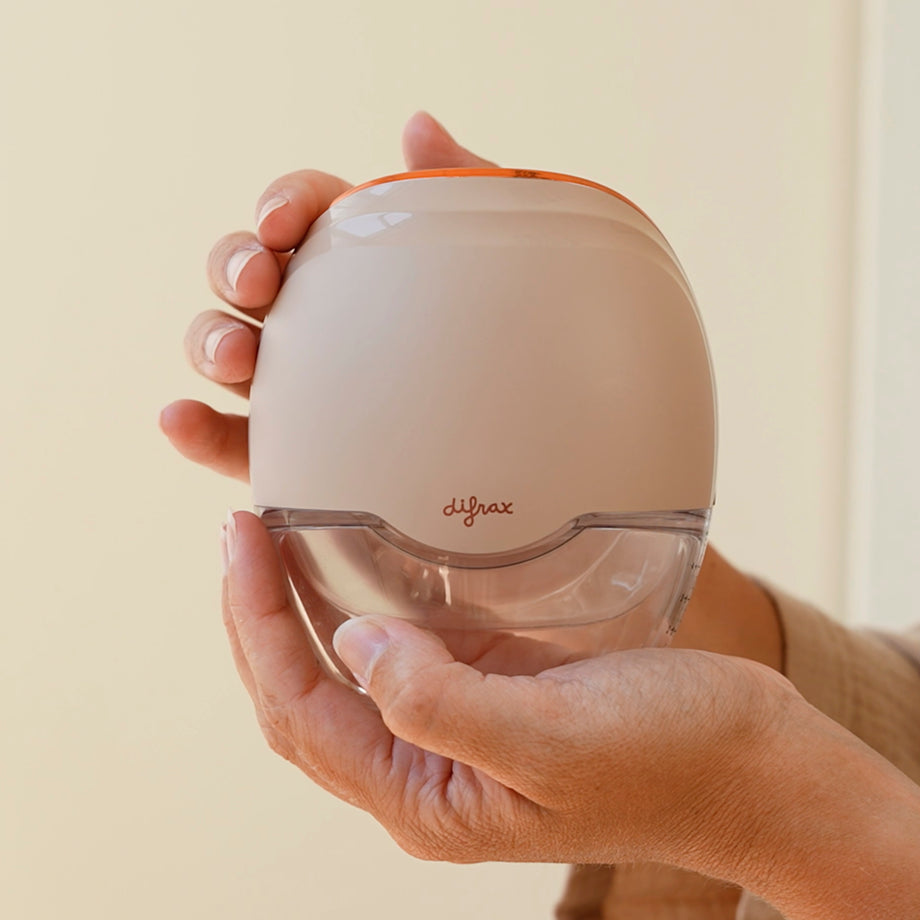
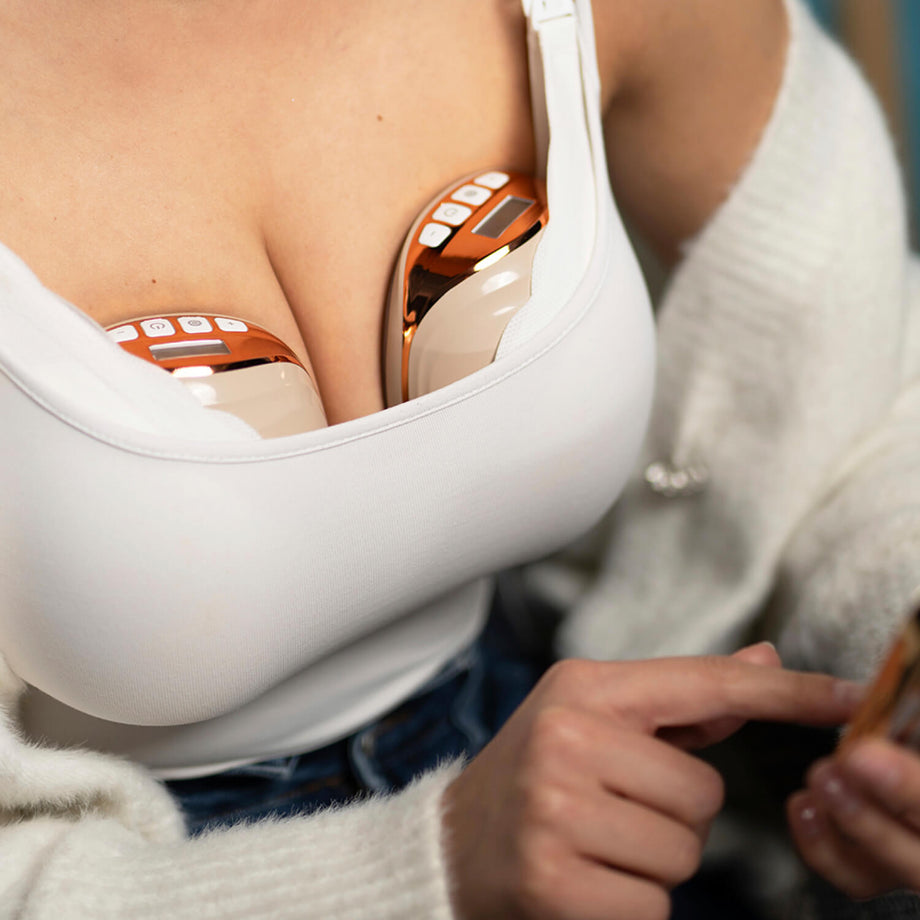
A pumping bra is specially designed to be worn while pumping, freeing up your hands for other activities. A pumping bra is designed for a regular breast pump, where a funnel-shaped breast shield is attached to a bottle. You don't need a pumping bra for the Difrax breast pump. The pump fits entirely into the cup of your bra. With a nursing bra, you can detach the cup at the front to breastfeed the baby directly. It is not necessary to use a nursing bra with the Difrax pump, but it is possible.
What breast shield sizes are there, and which size is right for me?
The set includes one inner shell (24 mm) and three additional insert sizes (17, 19, and 21 mm). A well-fitting inner shell is important for comfortable and efficient pumping. To find the correct size, measure the size of your nipple. The nipple determines the size of the inner shell, not the size of your breast. Measuring the nipple is easy. Use a tape measure or ruler to measure the diameter of the nipple at its base, excluding the areola. It may be that the other breast requires a different size. Therefore, measure the nipple of both breasts.
Please note the following:
- The nipple should be able to move freely within the shell.
- Ensure that the areola is not pulled into the breast shield.
- When placing the shield, 1-2 mm of space around the nipple is normal.
- A shield that is too large or too small can lead to pain, damaged skin, and poor milk production.
- Never pump for longer than 30 minutes.
The inner shell doesn't fit, what now?
If all four inner shells do not fit properly on your nipple, please contact our customer service. In addition to these four sizes, there is one extra size of 27 mm. This is available from customer service if required.
How much does the breast pump weigh?
The breast pump weighs 275 grams empty. During pumping, the weight will depend on the amount of milk pumped into the reservoir.
What is the size of the breast pump?
The breast pump's dimensions are 12.5 cm high, 10.5 cm wide, and 7.5 cm deep. The container holds a total of 120 ml of milk. If you produce more milk, you can pause the pump in between.
Maintenance
Capacity and Storage
How much milk fits in the collection cup/container?
The milk reservoir has measuring marks to help you keep track of how much milk you express. The container can hold a total of 120 ml of milk.
I produce a lot of milk. Can I stop the breast pump to empty the full collection cup?
Yes, you can. You can pause pumping midway. The best time to do this is when you notice that the milk is no longer dripping heavily, so that you have minimal to no milk loss.
I've lost a breast pump part, what should I do now?
If you are missing a part, please contact our customer service. They will endeavour to send the missing part to you as soon as possible.